This article was written by Diego Cardini, a drummer, performer and educator based in Buenos Aires, Argentina. He started drumming at the age of 12 and has played in numerous bands across a wide range of musical styles. He is the founder of The Drum Ninja, a drumming resource for musicians of all levels.
There's a particular kind of problem that finds every music teacher sooner or later. You've been asked to run a rhythm section workshop, or a samba unit, or a whole-class ensemble lesson. You look at what you have in the cupboard and realise it's a djembe with a loose head, two tambourines that rattle whether you hit them or not, and a glockenspiel that hasn't been tuned since 2019. You have creative ambitions for the lesson but your budget doesn’t match.
I've spent years teaching drums and building percussive ensembles across different contexts. The question of how to build a genuinely usable percussion section without overspending is one I've had to answer repeatedly. Not every answer costs what the catalogue suggests it should. Here's how I think about it.
Start with what actually gets used
The first mistake I see when schools invest in percussion is buying variety at the expense of depth. Twenty different instruments sound like a well-resourced department. In practice, what you actually need for a functioning ensemble is enough of the right instruments to give every student a meaningful role.
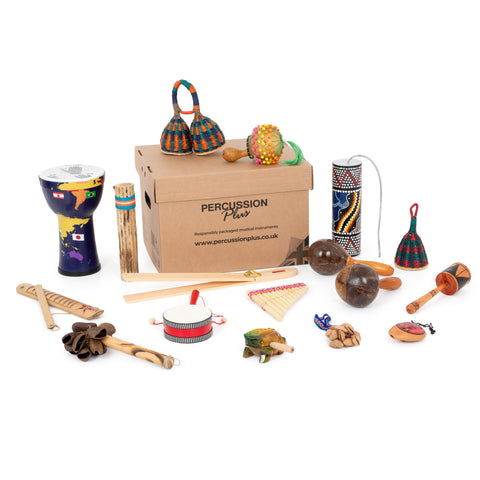
For a whole-class percussion ensemble, the most versatile core setup is built around four groups. Bass voices, which include djembes, surdo-style hand drums, or frame drums. Mid voices, which include bongos, congas, or medium djembes. High voices, which include shakers, claves, and woodblocks. And a pulse keeper, usually a single larger drum or a cajon to anchor the rhythm.
You can run engaging, genuinely musical sessions with this four-group model and a class of thirty. You don't need thirty different instruments. You need enough of each type to distribute across groups, with a few extras for the inevitable drumhead emergency.
Djembes: Where most of your budget should go
If I'm advising a school on where to concentrate spending, it's almost always on a smaller number of better-quality djembes than a large number of cheap ones. A poorly made djembe doesn't respond properly. The bass and slap tones are indistinct, and students find it genuinely difficult to create the dynamic variation that makes ensemble percussion engaging. When the instrument doesn't respond to what they do, motivation drops.
This is one of the reasons percussion units underperform. Not because students aren't interested, but because underpowered instruments make the relationship between effort and musical result feel arbitrary.
Rope-tuned djembes in the 10 to 12-inch range tend to be the most practical for secondary classroom use. They're durable enough to survive the realities of shared instrument storage. They produce a clear, full-bodied tone and they're light enough for younger students to position correctly.
Buying five good-quality djembes is almost always a better use of money than buying ten cheap ones, even if the total spend is similar.
Think in complementary pairs
One practical framework that's helped me build percussion sections on a budget is thinking about instruments in complementary pairs rather than as individual items.
A cajon and a djembe together cover the full bass-to-mid register. Two contrasting shaker types, one dry and articulate and one fuller and more sustained, give students enough tonal variety to create interesting rhythmic conversations. Two sizes of woodblock produce the kind of tonal contrast that makes simple repeated patterns sound genuinely musical.
This matters for budgeting because it stops you from filling in gaps with instruments that duplicate each other. Three very similar djembes and no real high-voice instruments produce a muddy, tonally uniform ensemble.
Spending a third of that djembe budget on a few good shakers, claves, and a quality woodblock or two gives the whole group a cleaner, more interesting sound.
Maintenance is cheaper than replacement
The percussion section that costs the least over time is the one that gets maintained. Rope-tuned djembes can lose tension gradually without anyone noticing. The result is a dull, indistinct tone that makes even a well-designed lesson feel flat.
Showing students how to tighten the ropes by pulling the verticals downward takes about three minutes and makes an immediate difference to the sound. Making this a normal part of every session builds instrument awareness in students and keeps your djembes performing properly for significantly longer.
Drumheads on frame drums and hand drums will eventually need replacing. Keeping a small stock of replacement heads and the basic maintenance tools to fit them means a split head becomes a five-minute fix rather than an instrument that sits in the corner for a term.
For stick-played percussion, designating specific mallets for specific instruments prevents the cross-contamination of beaters that gradually damages both heads and mallets over time. These small habits extend the life of instruments substantially, which matters enormously when budgets are limited.
The case for cajon in a school context
If budget allows for one non-standard addition to a classroom percussion section, I'd usually suggest a cajon. They're compact, require no maintenance beyond occasional screw tightening, and produce a surprisingly full low-end bass note and a sharp, cutting slap tone from the same surface.
Students take to them almost immediately because they feel familiar even before they've learned the technique. In ensemble contexts, a cajon played by a slightly more experienced student effectively provides the pulse anchor for the whole group. This frees up every other instrument to play more rhythmically complex parts.
The teaching opportunities this creates are substantial. Discussing how rhythm sections function, how a bass voice creates space for everything else, how dynamics work across a group. All of it sits naturally within the curriculum aims around ensemble performance and music theory.
Percussion instruments like the cajon also work across a genuinely wide age range. If you're thinking about which students to introduce to rhythm-based learning first, this guide on the best age to start playing drums covers how children respond to percussion at different developmental stages. It's a useful context when planning a unit for mixed-ability or mixed-age groups.
A word on snares and kit drums in a classroom
The temptation when a school has a drum kit is to centre the whole percussion ensemble around it. I'd gently argue against this in most whole-class settings. A drum kit isolates the player, makes it difficult for students to observe technique, and tends to concentrate the most exciting instrument in the hands of one student for most of the lesson.
Hand percussion instruments distribute participation more evenly and create a more collaborative dynamic in the room. A circle of students, each playing a djembe or a shaker, learns something different from a student sitting behind a kit while twenty-nine others watch. The kit works better as one voice in the ensemble than as its centrepiece.
Building over time
Almost no school builds its ideal percussion section in one go. The approach that works best is to identify the two or three instruments that are genuinely limiting your current teaching, the gaps that stop you running certain activities, and prioritise those first.
Spreading a modest budget thinly across everything rarely moves things forward. A small number of well-chosen, well-maintained instruments will do more for your teaching than a large collection of instruments that don't perform reliably. The goal isn't to have everything, it's to have enough of the right things to make great teaching possible.
Build your bass voices first, then add your high voices and fill in the gaps with complementary pairs as the budget allows. Maintain what you have from the beginning, so each new cycle starts from a higher baseline rather than replacing what's deteriorated. Done in that order, even a modest annual percussion budget compounds into something genuinely useful over three or four years.
The students who come through your department in the meantime get to play instruments that actually respond to them, which, in my experience, is the single thing most likely to make them want to keep playing.

Diego Cardini (The Drum Ninja) in action